Why Second-Floor Windows Look Worse Than the Ones Downstairs
The windows you can't touch tend to get the least attention, and the weather works on them all the same.
October 27, 2026 · 4 min read
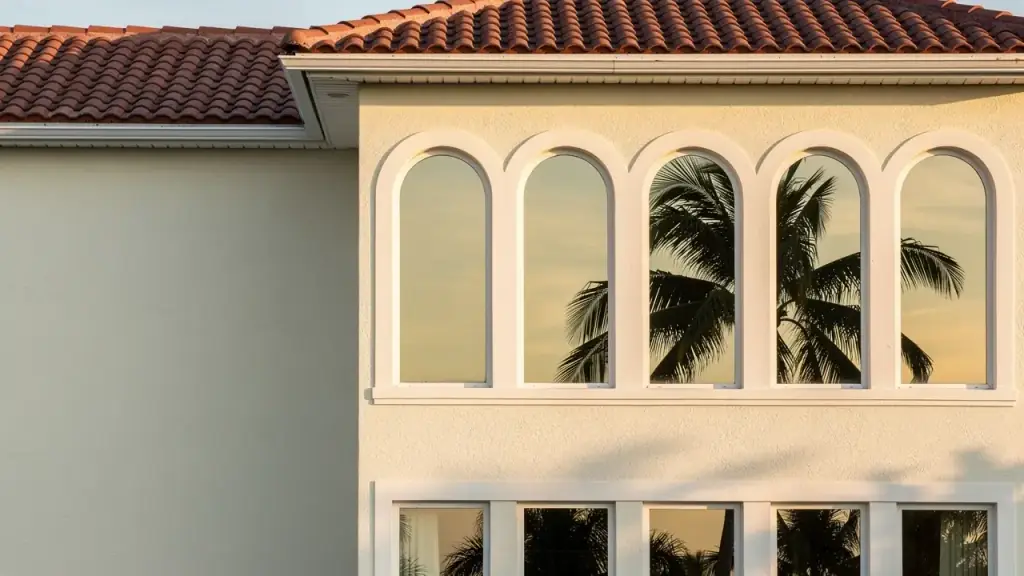
Walk around a two-story home in Naples and the pattern shows up fast. The sliders and picture windows at eye level look fine. Then you look up at the arched uppers and the bedroom glass under the barrel-tile eave, and they look like they're sitting behind a thin veil.
That isn't your imagination, and it isn't because upstairs glass is a different kind of glass. It comes down to how those windows get seen, how they get reached, and what the weather leaves on them. Once you know the reasons, the fix makes more sense too.
Nobody looks at them up close
Ground-floor glass gets noticed. You pass it every day, a dog leaves a nose print, a kid leaves a handprint, and the moment it looks off somebody wipes it or puts it on a list. Upstairs glass is only ever seen from across the lawn or from the driveway, where a little film and a few spots blend into a general haze.
So the buildup is slow and quiet. There's no single day when the upstairs windows got dirty. They drifted, a week at a time, until one afternoon you glance up and wonder when the house started to look tired.
Sun angle makes it worse. Second-floor glass usually faces more open sky, so it catches more direct afternoon light and more of whatever falls out of the air. A film that hides in the shade of a lanai on the first floor shows plainly upstairs once the sun hits it sideways.
Reaching them is the other half of the story. Upstairs windows on a barrel-tile home often sit above a roof slope or a screened lanai, so there's no easy place to stand and no good angle to work from. Most owners wisely don't climb up there, and so the glass waits.
What the hose and long brush really does
The usual homeowner fix is a garden hose and a brush on an extension pole, worked from the grass. It's a reasonable thing to try, and it does knock off loose dust and pollen. It rarely does more than that.
The trouble is geometry. From the ground you're pushing a brush up at a steep angle, so the pressure on the glass is uneven. The bristles skim the middle of a pane and miss the corners and the edges where glass meets frame. Those edges are exactly where grime sits longest.
Then there's the rinse. Water from a hose often carries dissolved minerals, and when a wet pane dries in the Florida sun, those minerals stay behind as a fresh set of tiny spots. You haven't removed the problem. You've swapped one film for another, and the new one is harder to see until the light turns.
A brush can also push a film around instead of lifting it. The glass looks wonderful for a few minutes while it's wet, then dries into streaks that follow the strokes of the bristles. Plenty of people stop there and decide the windows just look like that now. They don't have to.
What hand washing changes
One Gulf Window Cleaning customer, B.A. M, left a five-star review for having their second-floor windows hand washed. Their verdict: “The result is so much better than doing it from the ground with a hose and long brush.” That's the whole story in one sentence. Same glass, same sun, different result.
When someone washes by hand, they're at the glass. They can see the corners, work the edge where pane meets frame, and finish each window before water has a chance to dry on it. There's no secret product behind that. It's just being close enough to see what you're cleaning, and treating each pane as its own job.
That matters most on the windows that are hardest to judge from below, like transoms, arched uppers and the tall panes beside a front entry. Those are the ones a brush on a pole can't really reach square on.
How to read your own upstairs glass
You can check this yourself in a couple of minutes. Stand inside at an upstairs window and look through the glass at something distant, like a royal palm or a neighbor's roofline. Then do the same at a downstairs window and compare the two.
- A haze that makes distant palms look soft instead of sharp
- Small round spots in clusters where sprinkler spray or rain dried on the pane
- A grimy band along the bottom edge of the glass where water runs and settles
- Curved streaks or swirls that show up when the sun is low and sideways
If the upstairs glass looks noticeably duller than the downstairs glass, you're looking at accumulated film, not a bad window. Glass that's been cleaned properly looks like there's nothing there at all.
Gulf Window Cleaning washes windows by hand for homes in Naples, second-floor glass included. Call (305) 417-8676 and tell us how many windows you have and how many are upstairs.
Gulf Window Cleaning, (305) 417-8676
Call (305) 417-8676More articles
What Salt Air, Sprinklers and Summer Storms Leave on Naples Glass
Three different things dirty a window in Naples, and they leave three different marks once you know where to look.
Hand-Washed Versus Sprayed and Rinsed: What Changes on the Glass
Both methods leave a window wet and then dry, but they don't leave the glass in the same state.